
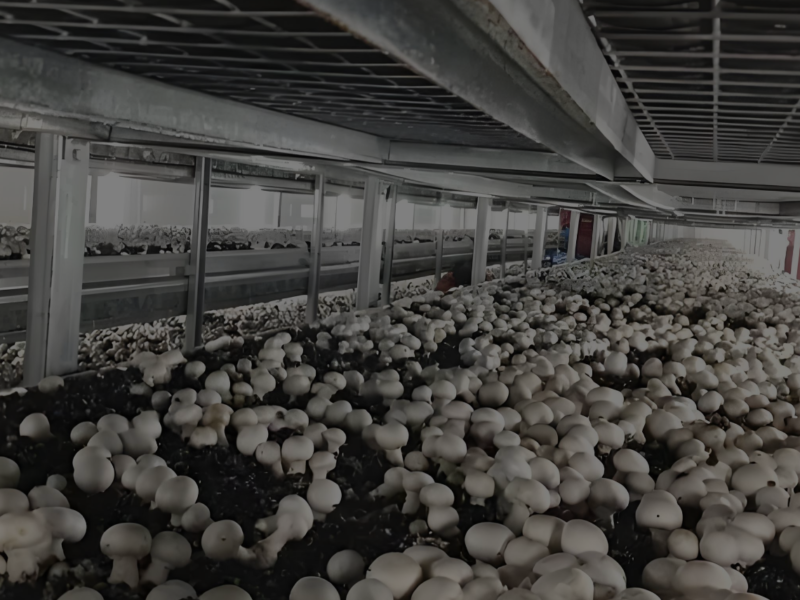
Founded in 2010 and located in Langxia Town, Jinshan District, Shanghai Lianzhong Cooperative has built over 50 modern mushroom houses and more than 30 secondary and tertiary fermentation tunnels. It mainly engages in the industrial cultivation of Agaricus bisporus and has established a full-industry-chain modern production system centered on tertiary-fermented compost for Agaricus bisporus, integrating raw material selection, precision tertiary fermentation technology, localized strain breeding and intelligent environmental control of mushroom houses.
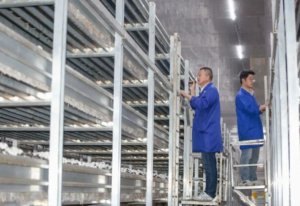
At present, Lianzhong Cooperative is an intelligent Agaricus bisporus cultivation base in Shanghai with high technological content, large cultivation scale and improved production, supply and marketing channels. It also serves as an experimental base of the Shanghai Academy of Agricultural Sciences and a National Demonstration Farmer Cooperative. Its “Lianzhong No.1” Agaricus bisporus has obtained green food certification and been included in the National List of Famous, Special, High-quality and New Agricultural Products.
Langxia Town has a long tradition of mushroom cultivation. As early as the 1970s, local farmers began to grow Agaricus bisporus, known as white button mushroom—the favorite on Shanghainese dining tables.
In 2010, Chen Lingen came to Langxia Town and built more than 70 mushroom greenhouses. At that time, traditional cultivation was basically rain-fed, with high labor intensity and open-air compost fermentation. In December 2011, Chen first came into contact with the industrial edible fungi production mode at a forum. He immediately contacted foreign experts attending the forum and went to the Netherlands to inspect the industrial cultivation technology and management of Agaricus bisporus.
Farm work that used to take 5 days of manual labor can now be fully completed in just 1 hour with automated equipment. The trip to the Netherlands made Chen deeply experience the high efficiency of modern agriculture, and he secretly resolved to “be the first to break new ground” and try industrial production of Agaricus bisporus in Shanghai.
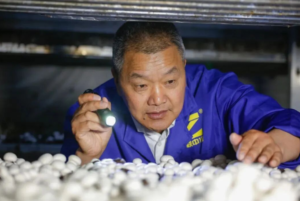
He took immediate action. Only three months later, under the guidance of experts from the Shanghai Academy of Agricultural Sciences, an imported multi-functional feeder was put into use at his mushroom base in Langxia Town. At that time, there was no precedent for industrial Agaricus bisporus production in China. Chen and his technical team went to Europe many times to learn relevant technologies and management experience, delving into professional knowledge and overcoming key difficulties.
Through continuous learning, accumulation and hard work, Chen’s “mushroom dream” has gradually come true. Years of sweat and perseverance have turned 72 mu of land into a “golden field” with an output value of 2 million yuan per mu. By introducing modern technologies and advanced management models, the output value of Agaricus bisporus has been greatly increased. Each cultivation cycle lasts 33 days, with a yield of 35 kg per square meter per cycle, and 11 cycles can be achieved annually—nearly 20 times that of traditional cultivation. He has also invested over 200 million yuan to build a 32,000-square-meter modern mushroom house equipped with advanced tertiary fermentation tunnels, with a daily output of fresh mushrooms exceeding 20 tons.
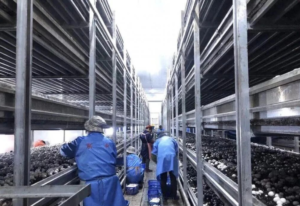
Output and output value have never been the sole pursuit of Lianzhong Cooperative. In exploring green development and circular economy, it has focused on the raw materials for Agaricus bisporus cultivation—rice and wheat straw, and chicken manure. Technical personnel have carried out joint research with the Edible Fungi Research Institute of the Shanghai Academy of Agricultural Sciences, conducting repeated comparison and fermentation experiments to find the optimal ratio, and successfully built an agricultural waste recycling model of “rice and wheat straw — mushrooms — organic fertilizer”.
Currently, the cooperative consumes 60,000 tons of rice and wheat straw and 40,000 tons of livestock and poultry manure annually, and can convert mushroom cultivation waste into 100,000 tons of organic fertilizer for field application. This not only effectively reduces carbon emissions and environmental pollution, but also explores a new path for ecological and green agricultural development.
In collaboration with public partners, Business connects local businesses and job-seeking residents with government-funded resources.
In collaboration with public partners, Business connects local businesses and job-seeking residents with government-funded resources.