
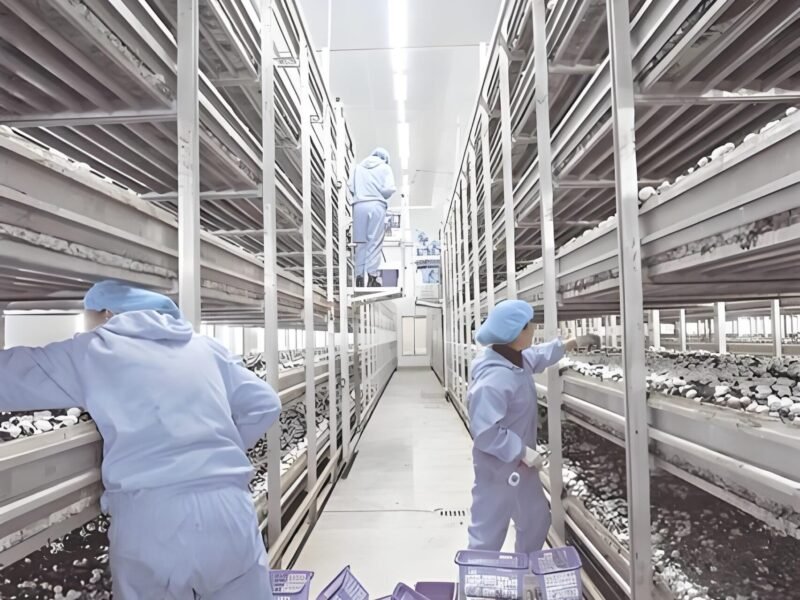
The intelligent mushroom factory has newly installed “air conditioners” and automated control systems in its growing rooms. White button mushrooms are popping up, and the villagers’ faces are beaming with anticipation for a bumper harvest.
In recent years, local villages and enterprises in the jurisdiction have jointly promoted the standardized and intelligent cultivation of mushrooms, transforming from simple trench-based mushroom sheds to modern factory-scale production. Taking advantage of the cooperation opportunities between state-owned enterprises and rural areas, they have actively raised mushroom processing standards and brought their products into supermarket channels.
Standardized and intelligent cultivation enables year-round harvesting.
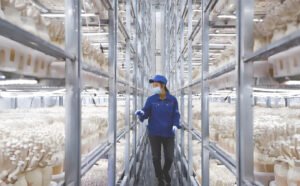
The so-called “air conditioners” are actually a set of advanced temperature control equipment and precision irrigation systems. Equipped with various IoT devices in the growing rooms, they can maintain temperature and humidity at the optimal ranges. These new devices effectively inhibit the growth of miscellaneous bacteria and better control the growth cycle of button mushrooms, putting an end to the reliance on favorable weather conditions for a good harvest. This year, all 18 growing rooms in the village have been fitted with the new equipment.
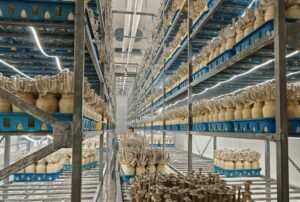
Intelligent cultivation has significantly boosted mushroom yield and quality. High-end varieties such as shimeji mushrooms, morel mushrooms, beefsteak mushrooms and lion’s mane mushrooms have also been successfully trial-grown in the village.
As the scale of mushroom cultivation expanded, the waste residue generated during production became a burden. Dr. Ma Xiaolong, director of the Edible Fungi Research Office at the Vegetable Research Institute of Wuhan Academy of Agricultural Sciences, and his team have developed a unique local resource-recycling cultivation model called “One Substrate for Three Mushroom Varieties and Four Applications” in the village.
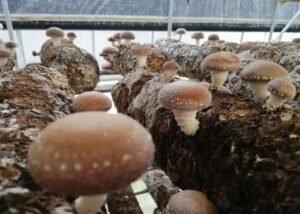
Under this model, a single batch of cultivation substrate is first used to grow king oyster mushrooms, followed by straw mushrooms and then button mushrooms. The remaining waste is further processed into organic fertilizer that is returned to farmland. This model not only greatly reduces the labor intensity of substrate replacement for villagers, but also ensures year-round mushroom harvesting in the village. Thanks to this circular cultivation model, the village can digest 3,100 tons of crop straw annually and cut pesticide usage by 70%.
Recently, the village’s edible fungi industrial park project has entered the equipment installation and commissioning phase. Once officially put into operation, it will be able to produce 30,000 bags of king oyster mushrooms per day and drive employment for over 200 villagers in the surrounding areas.